 Pokemas Lab
POKEMAS LAB · DAMAGE STUDY
Physical Moves ↑ Next: Stack More or Attack Now?
By SciPocket · Published October 15, 2026 · Calculated October 15, 2026 · Dataset: October 14, 2026
You have a few ranks of Physical Moves ↑ Next. Should you attack now, or spend another turn building up more? We compared three ways to use those boosts, then checked the results with Poppy’s moves.
Using the same move twice? Splitting your boosts between the attacks usually gives about the same total damage as spending them all at once. A stronger buddy move gains more from each rank. But if you skip an attack to gain boosts, you can end up dealing less damage overall.
We calculated the numbers locally with the same engine used by the Pokemas Lab damage calculator. We start with simple examples, then compare Poppy’s actual moves. These are calculated results, not damage measured in the game.
1. Your next physical attack uses all stored ranks
| Setting | What to know |
|---|---|
| Per rank | Each rank adds 40% of move power, up to 10 ranks. This bonus can add together with passive bonuses, so one rank does not always multiply final damage by 1.4. |
| Physical regular / buddy moves | Applies. The buddy move tested here is Poppy’s Steel-Hard Gigaton Hammer. |
| Sync / max moves | Physical Moves ↑ Next is neither applied nor consumed. Sync Move ↑ Next is a different effect. |
| Spending ranks | A qualifying physical attack uses the entire stock. You cannot choose to spend only two out of four ranks. |
| Reapplication | After the first attack uses your ranks, you need to gain new ones before the second attack. You cannot store more than 10. |
2. Test 1: 4+0 or 2+2 on equally strong attacks?
Start with two uses of the same physical move. Each deals 1,000 damage at the maximum damage roll without boosts. We spend four ranks in total, either all on the first attack or split between both attacks. No other move-power bonuses apply in this example.
Scroll the table horizontally to see all columns.
| Boost allocation | First attack | Second attack | Total damage (max) |
|---|---|---|---|
| 4 +0 | 2,600 | 1,000 | 3,600 |
| 3 +1 | 2,200 | 1,400 | 3,600 |
| 2 +2 | 1,800 | 1,800 | 3,600 |
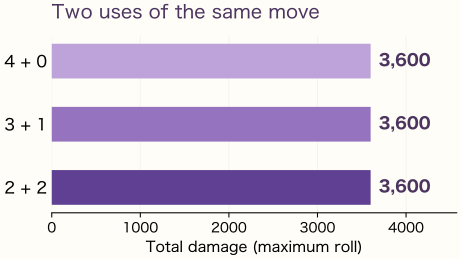
Under these conditions, the allocation only changes which attack receives the extra damage, so the total is unchanged. Front-loading can still help defeat an enemy before a dangerous action. Also consider damage wasted beyond the target’s remaining HP.
3. Test 2: save boosts for a stronger buddy move?
Now compare a regular move that deals 1,000 damage with a physical buddy move that deals 3,000, both at the maximum roll without boosts. How should we split four ranks between them?
Scroll the table horizontally to see all columns.
| Boost allocation | Regular move | Buddy move | Total damage (max) |
|---|---|---|---|
| 4 +0 | 2,600 | 3,000 | 5,600 |
| 2 +2 | 1,800 | 5,400 | 7,200 |
| 0 +4 | 1,000 | 7,800 | 8,800 |
Each rank adds 400 damage to the regular move but 1,200 to the buddy move. Saving all four ranks for the buddy move gives 8,800 total damage, compared with 5,600 when they all go into the regular move. Under these conditions, the stronger move gets more damage from each rank.
Existing physical boost ranks are consumed if you use a qualifying regular physical attack before the buddy move. To attack first and then boost the buddy move, you need reapplication between them. Check gauge, move points, and unlock conditions for any setup actions.
4. Test 3: is spending one action on boosts worth it?
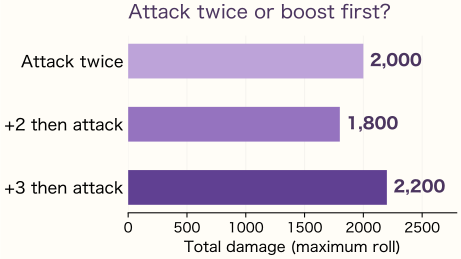
Suppose your attacker has time for two actions. It can attack twice for 1,000 damage each, or use its first action to gain boosts and attack only once. For now, the setup move only grants boosts: it deals no damage and gives no stat increases, extra sync countdown reduction, or other benefits.
| First action | Second action | Total damage (max) |
|---|---|---|
| Attack: 1,000 | Attack again: 1,000 | 2,000 |
| Grant 2 boost ranks | Attack: 1,800 | 1,800 |
| Grant 3 boost ranks | Attack: 2,200 | 2,200 |
A +2 setup adds 800 damage, less than the 1,000-damage attack it replaces. Attacking twice therefore wins by 200. A +3 setup adds 1,200, enough to beat two attacks.
Let a teammate apply the boost
If an ally supplies +2, the attacker can still attack twice, raising its total from 2,000 to 2,800. But that uses two attacker actions plus one support action. Compare against the support’s alternative attack or healing; do not interpret this as a 40% increase in real-time DPS.
Both an ordinary attack and an ordinary setup move advance the sync countdown. Over the same two actions, granting boosts alone does not add extra countdown reduction. A move that also accelerates the countdown, heals, or sets a field effect needs a broader comparison.
5. Actual pairs: Poppy’s regular and buddy moves
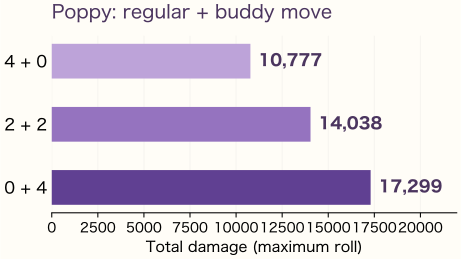
Next, we compare Poppy’s Play Rough and Steel-Hard Gigaton Hammer, her physical buddy move. The example team is Poppy & Tinkaton, Arc Suit Steven & Metagross, and Sygna Suit Nemona & Scream Tail. We calculate how much damage Poppy deals when four boost ranks are split between her two moves.
Each row assumes Poppy has the listed ranks immediately before each attack. The totals do not include the actions needed to gain those ranks. Full team and target settings are below the results.
Scroll the table horizontally to see all columns.
| Boost allocation | Regular move | Buddy move | Total damage (max) |
|---|---|---|---|
| 4 +0 | 2,991 | 7,786 | 10,777 |
| 2 +2 | 2,232 | 11,806 | 14,038 |
| 0 +4 | 1,474 | 15,825 | 17,299 |
| Buddy-move ranks | Buddy damage, min–max |
|---|---|
| 0 | 7,008–7,786 |
| 2 | 10,625–11,806 |
| 4 | 14,242–15,825 |
| 10 | 25,094–27,882 |
Here, raising the buddy move from zero to four ranks adds 8,039 at the maximum roll. Ten ranks give a maximum of 27,882, but you must account for attacks skipped and support actions used to reach that stock. A bigger single hit does not necessarily make waiting worthwhile.
Team setup and target settings
Steven serves as a support here, but his in-game role is Multi. A Support-role option is Bede (Champion) & Articuno: his Trainer move raises all allies’ Attack, Sp. Atk, and critical-hit rate by two ranks and grants one rank each of Physical and Special Moves ↑ Next. Evaluate such moves separately from pure boost-only setup.
Poppy can also give herself one physical boost rank with her Trainer move. Steven’s successful attacks grant a rank that Poppy can spend on her next physical attack; that new rank does not boost Steven’s preceding attack. Nemona supplies Paldea Circle (Physical) and Paldea Pride.
| Condition | Fixed value |
|---|---|
| Investment | All three: Lv.200 and move level 5 at their original star rating. No potential tickets, grid tiles, lucky skills, gear, theme-skill stat bonuses, EX, EX Role, or Superawakening. |
| Poppy’s Attack | Dataset Attack 612, +6 Attack ranks; effective Attack 1,101 after flooring. |
| Move power | Play Rough 133 / Steel-Hard Gigaton Hammer 540 (move level 5). |
| Opponents | One hypothetical target, Defense 300 at rank 0, neutral type effectiveness, no critical immunity, damage reduction, or special rules. |
| Critical hit / sync buffs | Critical hit on (Poppy’s passive); zero sync buffs. |
| Additive power-ups | Paldea Pride with two Paldea pairs: +35%; Iron Myth with two Steel pairs: +20%; total +55%. |
| Field / weather | Paldea Circle (Physical) +30%. No Zone; weather multiplier 1 (sun does not strengthen either move’s type). |
| Type rebuff | Steven’s entry effect gives Steel Type Rebuff -1 for the buddy move; Fairy Type Rebuff remains 0. |
The buddy move’s requirement of using one move beforehand is already satisfied. Each row sums snapshots with the specified ranks ready before each attack. These allocations are not claimed to have identical setup costs. Support damage and preparation actions are excluded from the totals.
These links prefill the move, stats, ranks, and multipliers for a single hit. No grid tiles are selected; passive and circle bonuses are entered as the fixed values above. They do not automatically reproduce a full team or sequence.
6. Save boosts for strong moves, but count setup actions
| Situation | Recommendation |
|---|---|
| Repeated identical moves | Same total ranks generally give the same total. Decide using KO timing, reapplication, and rounding. |
| A strong physical buddy move is ready | Favor the stronger move, and avoid consuming the stock on an intervening physical attack. |
| Skip an attack solely to gain +2 | Can lose to attacking twice. Compare extra effects as well. |
| An ally can grant ranks while attacking | Preserves the attacker’s actions more easily, but count ally actions and trigger timing. |
| Already at ten ranks | Align attacks and later grants to avoid wasting ranks beyond the cap. |
There is no single best number of ranks for every team. Start with the boosts your team can provide without delaying your main attacker. Before spending extra actions on setup, compare the damage you gain with the damage those actions could have dealt instead.
7. Calculation details and scope
Formula, multipliers, and rounding
floor ((P +ΔP) × (100 +q +40b) / 100)P is move power, ΔP is grid power addition, q is the percentage total of other power-ups in this additive term, and b is boost ranks. The floor function rounds down. This is the engine’s adjusted-power step; final damage also depends on offensive and defensive stats, critical hits, sync buffs, and field effects. Not every buff belongs in q.
With +100% already in the same term, adding the first rank changes the multiplier from 2.0 to 2.4: a 1.2× gain relative to no boost, not 1.4×. Each rank generally adds the same absolute amount, while the relative gain over your current damage gets smaller.
Scroll the table horizontally to see all columns.
| Ranks | No other power-ups | With +100% | Relative to +100%, no boost |
|---|---|---|---|
| 0 | 1.0× | 2.0× | 1.0× |
| 1 | 1.4× | 2.4× | 1.2× |
| 2 | 1.8× | 2.8× | 1.4× |
| 3 | 2.2× | 3.2× | 1.6× |
| 4 | 2.6× | 3.6× | 1.8× |
| 5 | 3.0× | 4.0× | 2.0× |
| 6 | 3.4× | 4.4× | 2.2× |
| 7 | 3.8× | 4.8× | 2.4× |
| 8 | 4.2× | 5.2× | 2.6× |
| 9 | 4.6× | 5.6× | 2.8× |
| 10 | 5.0× | 6.0× | 3.0× |
40b >100 +qFor identical moves in this simplified model, this condition means the gain after setup exceeds the skipped attack. The threshold is +3 with no other power-ups, or +6 with an existing +100%; +5 ties in the latter case. Recalculate when rounding or extra effects matter.
Rounding can break exact equality
Changing power to 101, Attack to 319, Defense to 127, other power-ups to +35%, critical hits on, and field multiplier to 1.5, with other settings unchanged, gives a small advantage to 2+2 due to adjusted-power floors and roll rounding. This does not mean distribution is always better.
| Allocation | Total, max roll | Total, 11-roll mean |
|---|---|---|
| 4+0 | 2,446 | 2,323.73 |
| 3+1 | 2,446 | 2,323.64 |
| 2+2 | 2,452 | 2,329.27 |
For the first three comparisons, regular-move power is 100, Attack is 1,000, Defense is 100, stat ranks and sync buffs are zero, and critical hits are off. There are no other power-ups, and weather and field multipliers are 1. Only the stronger-move comparison changes buddy-move power to 300.
Damage varies with the random damage roll. The main comparison tables assume both attacks get the maximum roll. The detailed calculations use 11 rolls from 0.90 to 1.00; the rounding table above also shows their simple average. This average assumes the move hits with the specified critical-hit setting; it does not account for accuracy or critical-hit probability. Two-hit ranges and averages are the sums of the individual hit results.
Stat and move-power values are rounded down by the same code used in the calculator. Some moves and skills have additional effects that scale with stored boost ranks; those need to be checked separately from the standard boost bonus. The Poppy results should not be assumed to cover every buddy move or special case.
We have not verified boost consumption when a move misses, is blocked by immunity, or is interrupted, nor all multi-hit and trigger-order exceptions. These examples assume the physical attack executes normally and hits. We have not measured real-time DPS, including enemy actions and animations. Boosts granted after a sync or max move do not strengthen that preceding sync or max move.