 Pokemas Lab
Fourth Gym Battle over 270 seconds: how far can special Fighting go?
By SciPocket · October 17, 2026
How much firepower could teams produce within the Gym Battle’s 270-second limit? Using the event-era roster, we compare eight types in both damage categories—16 conditions—over the same 270 seconds.
Team candidates, grids, and action orders are compared to maximize cumulative firepower within 270 seconds. Sync count is not fixed; normal, buddy, Tera and max moves that fit after the last sync are included.
The adopted special Fighting candidate scores 12.97 ×100 million with 6 sync moves. It ranks 3 from the bottom among the eight special types and reaches about 66% of the other seven types’ median.
These are cumulative firepower indices from an approximate model, not actual HP damage. They do not establish exhaustive maxima or in-game team rankings.
See 270-second results and adopted grids for all 16 teams →
Compare physical and special teams across eight types over the same 270 seconds
The comparison covers the eight weakness types in the fourth Pasio Gym Battle, Sinnoh Leaders Assemble. Special damage is immune in physical conditions, physical damage in special conditions, and attacks outside the weakness type score zero.
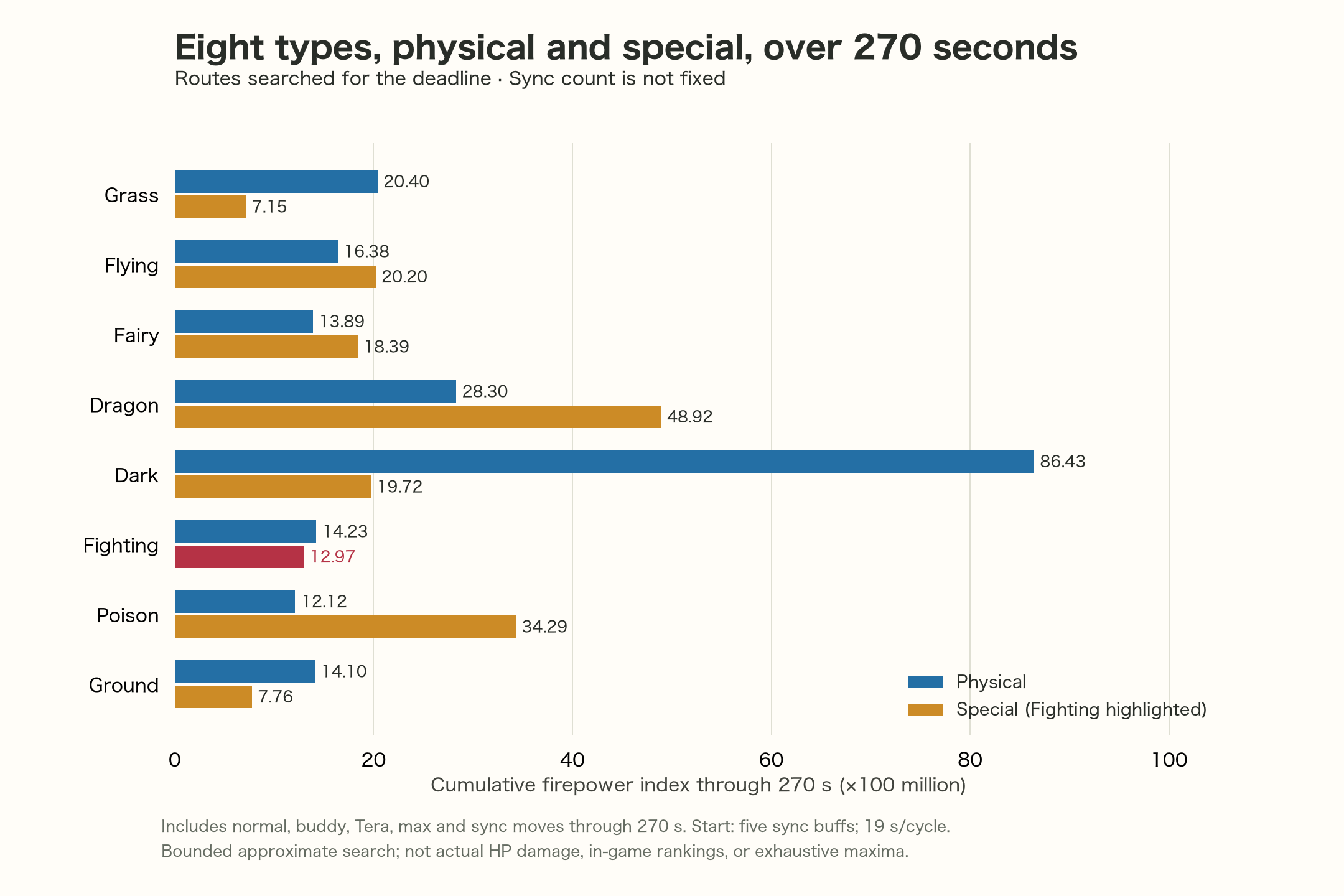
Countdown acceleration can bring sync moves, sync buffs, and post-sync support forward and may increase sync count within the deadline. Setup actions and the timing of limited buddy moves also affect the total.
Open the eight-type summary table
| Type | Opponents | Physical: 270-second total | Physical syncs | Special: 270-second total | Special syncs |
|---|---|---|---|---|---|
| Grass | Roark | 2,039,626,264 | 6 | 715,247,735 | 5 |
| Flying | Gardenia | 1,638,304,623 | 6 | 2,019,857,546 | 6 |
| Fairy | Maylene | 1,388,846,395 | 6 | 1,838,656,933 | 6 |
| Dragon | Crasher Wake | 2,830,229,727 | 6 | 4,892,254,425 | 7 |
| Dark | Fantina | 8,642,587,410 | 5 | 1,972,072,407 | 5 |
| Fighting | Byron | 1,423,355,587 | 5 | 1,296,908,163 | 6 |
| Poison | Candice | 1,211,872,539 | 6 | 3,429,195,543 | 5 |
| Ground | Volkner | 1,410,346,949 | 5 | 775,655,670 | 5 |
Compare special Fighting with other types
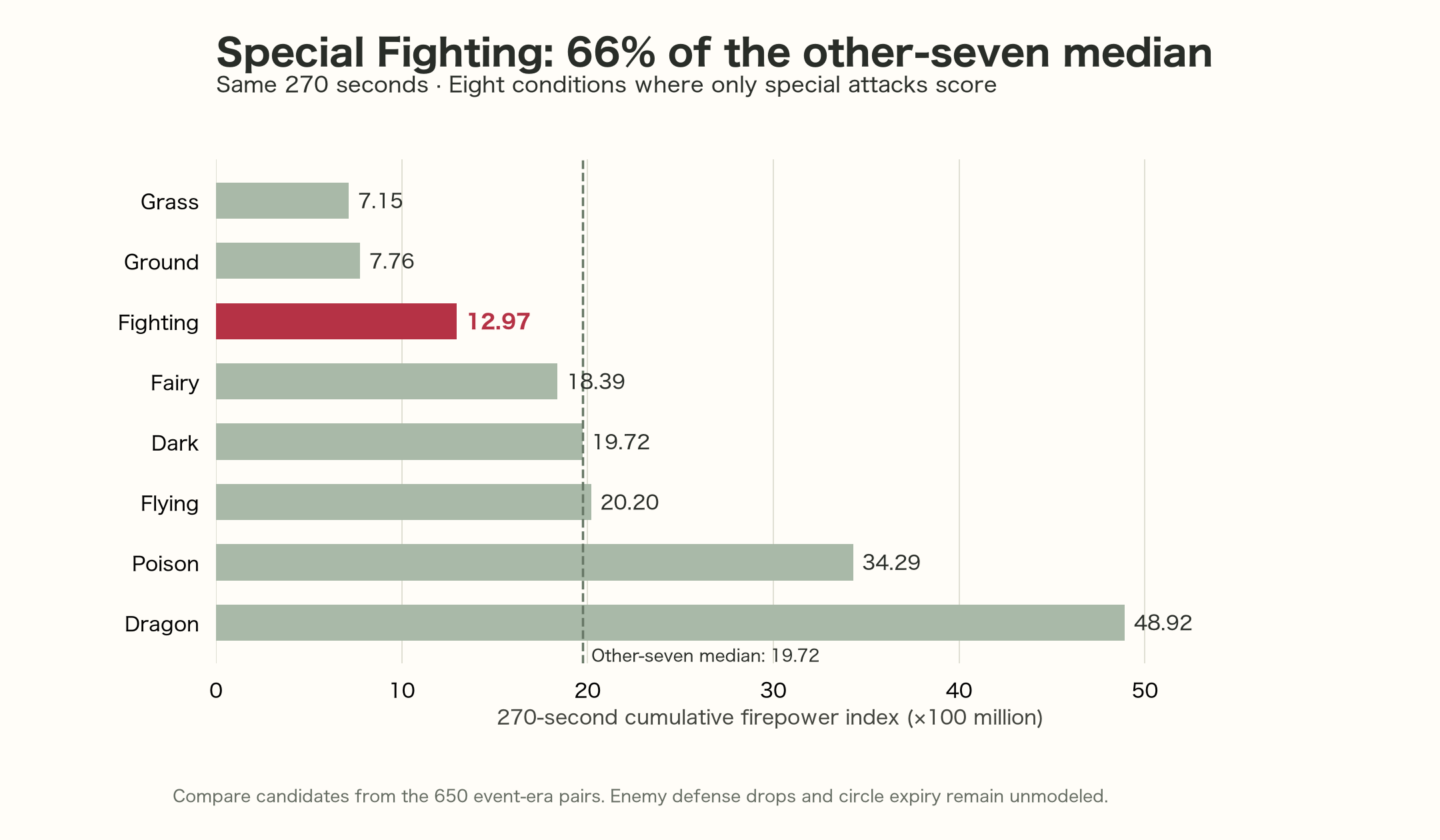
Special Fighting scores 12.97 ×100 million, compared with the other seven special types’ median of 19.72. It reaches about 91% of physical Fighting’s 14.23.
Relative to physical Fighting, these candidates do not show an isolated collapse in special Fighting. Its position among special types and its gap from physical Fighting are separate comparisons.
Differences among these candidates do not determine difficulty once enemy defenses, gauge, survival, and actual rosters are considered. This is one comparison for examining the disadvantage facing special Fighting.
Fighting teams and their 270-second action orders
Fighting · Physical
Juliana&Koraidon (Apex Build) / Arc Suit Korrina&Lucario / Rosa (Champion)&Meloetta (Aria Forme)
Fighting · Special
Sygna Suit Bede&Iron Valiant / Rosa (Champion)&Meloetta (Aria Forme) / Arc Suit Korrina&Lucario
The teams, grids, and routes are selected from candidates evaluated for 270 seconds. Attacks in an immune damage category can still apply the model’s supported countdown reductions, boosts, and field effects when their conditions hold. Moves that create a circle only on their first use do not overwrite it on every repeated use.
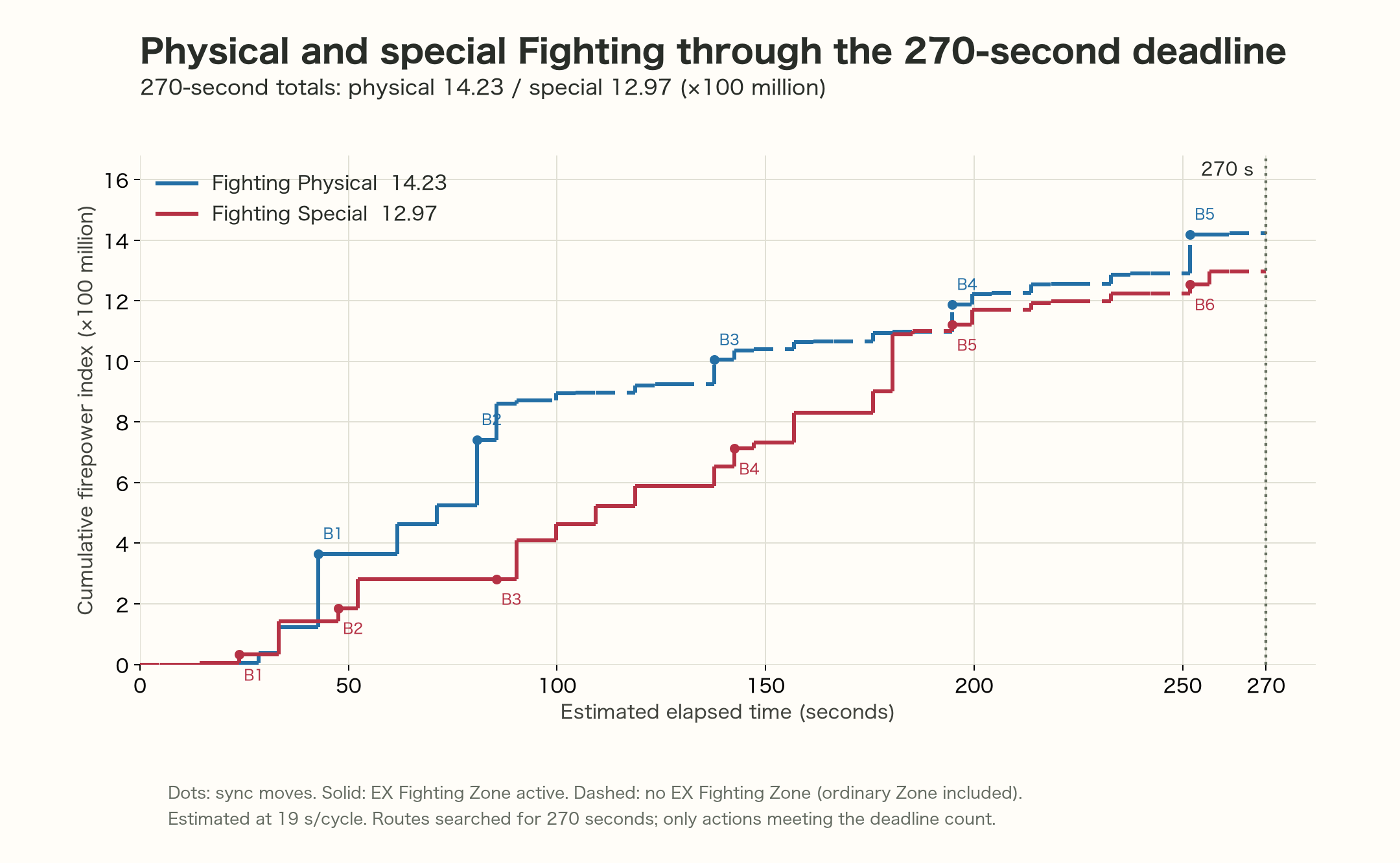
Dots mark team sync moves. Solid segments indicate active EX Fighting Zone; dashed segments indicate periods without an active EX Fighting Zone, including periods with only ordinary Fighting Zone.
The 270-second endpoint is shared by every team. Under the 19-second cycle approximation, an attack that would occur after 270 seconds is excluded. Horizontal tails do not add damage.
Also examine the limited pool of attack moves
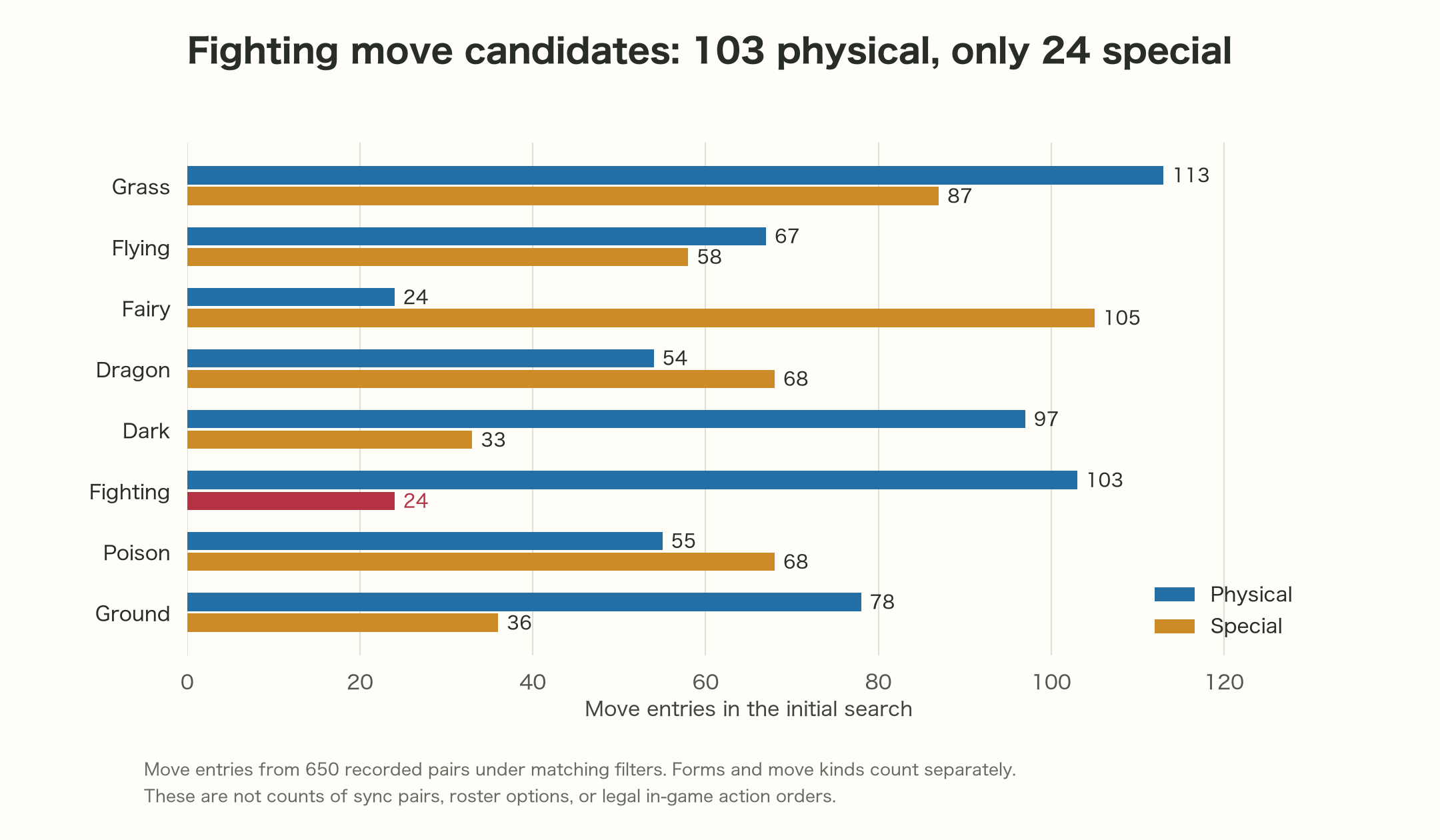
Under matching extraction conditions for the 650 event-era pairs, the initial Fighting pool contains 103 physical move entries and 24 special entries. These are move entries, with forms and move kinds counted separately, not numbers of sync pairs.
Review conditions and unmodeled effects
- Use the 650 recorded event-era pairs, excluding later Archie/Maxie releases and Academy pairs with a different training system. Compared teams include at least one regular Support-role pair.
- Move level 5, connected grids within 70 energy, 6★ EX/EX roles, and recorded Superawakening skills. Stats use recorded level-200 values plus grid additions, not complete in-game maxima including gear, potential tickets, and lucky skills.
- Start at five sync buffs, without cheer, against three weak opponents. Apply the selected damage-category immunity and super-effective-only rule.
- One cycle is three allied actions plus one enemy action in an estimated 19 seconds; each action takes a quarter-cycle. Each ally acts once per cycle, and syncs occur immediately when ready. Sync animations pause the clock; max moves consume time. These are not measured times.
- Narrow the team candidates and compare moves, sync moves, and grids that fit within 270 seconds. Include field-duration and Type Rebuff helpers and adopt a route with a high cumulative index among those compared. This is not exhaustive optimization over every team and route.
- Ordinary fields last 50 seconds plus 10 seconds per extension rank. The Field EX role’s extra 50 seconds on its deployment and the extra 30 seconds from reapplying an active matching EX field are handled separately.
- Track Type Rebuff by target and type and break duration by target actions. Effects do not retroactively increase earlier attacks.
- Damage gains from lowered Defense/Sp. Def, circle expiry, some intrinsic multipliers, gauge, HP/survival, and chance recovery are not fully modeled. Some effect conditions remain unresolved, so these results do not establish the strongest teams in actual play.
Interval scores, routes, grids, and reproducible 270-second links →
Compare your own roster over 270 seconds in the team optimizer →